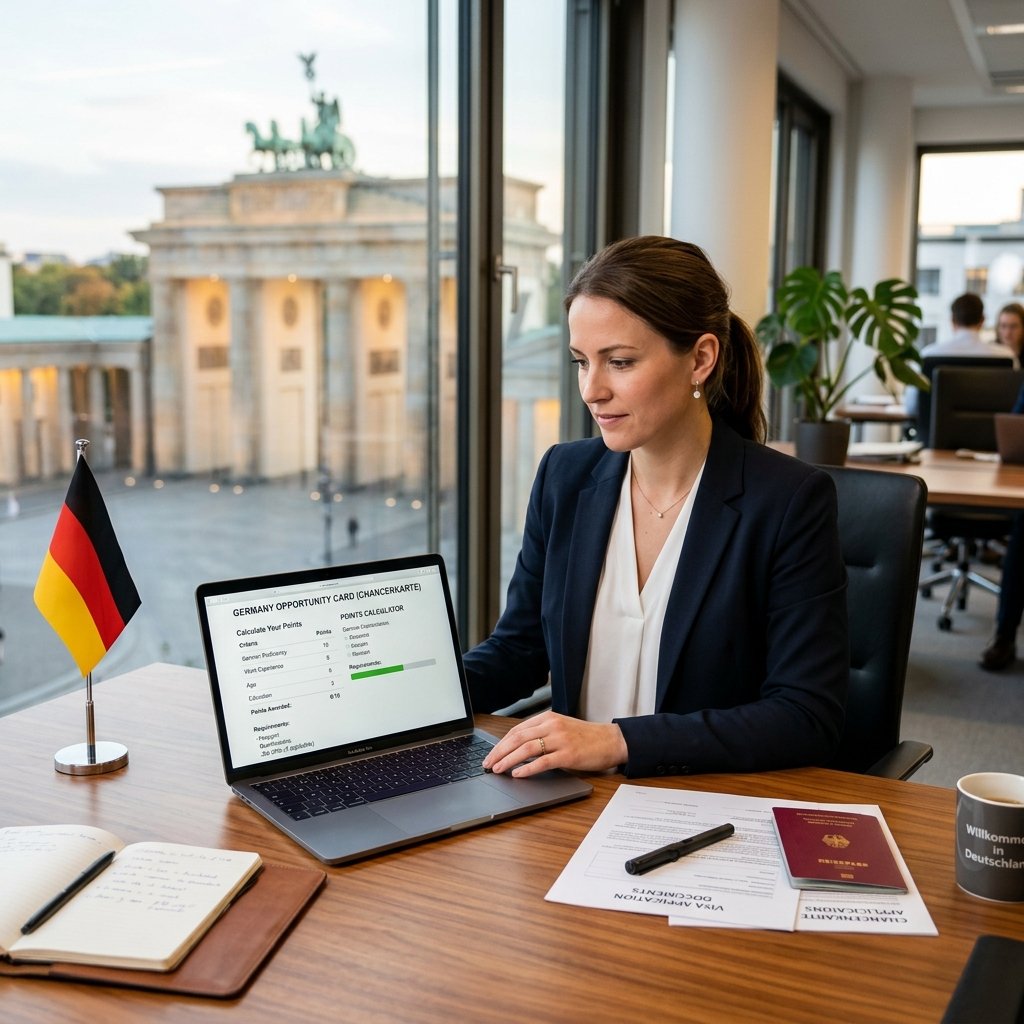
The introduction of the Germany Opportunity Card (Chancenkarte) has revolutionized the way skilled professionals from non-EU countries search for employment. Under the new Germany opportunity card requirements for 2026, eligible candidates can travel to Germany and reside in the country for up to one year to find qualified work without first needing a formal job offer. This points-based system is designed to address acute labor shortages in Germany’s robust industrial, engineering, and digital economies. By allowing job seekers to enter the country legally, Germany provides a direct, flexible pathway for international talent to connect with local employers and transition into long-term residency.
⭐ Key Takeaways
- Points-Based Entry: Applicants must score at least 6 points based on criteria like language skills, professional experience, age, and ties to Germany.
- Basic Prerequisites: Every applicant must hold a recognized university degree or vocational qualification, plus basic German (A1) or English (B2) language skills.
- Financial Proof: Job seekers must demonstrate they have sufficient funds (approx. €1,027 per month) to support their stay in Germany.
- Work Allowance: While searching for a permanent job, cardholders can work up to 20 hours per week in secondary jobs or complete trial work periods.
Core Prerequisites for the Germany Opportunity Card
Before calculating points under the Chancenkarte system, all applicants must satisfy a set of basic requirements. These requirements act as a gateway; if you do not meet them, you cannot apply, regardless of your potential point score.
First, you must have completed a university degree or a vocational training program that is officially recognized in Germany. The qualification must have required at least two years of study or training. To verify this, applicants often use the German Anabin database or obtain a statement of comparability from the Central Office for Foreign Education (ZAB).
Second, you must possess basic language proficiency. You must prove either a minimum of level A1 in the German language or level B2 in English, verified through official test certificates like Goethe-Institut, TestDaF, IELTS, or TOEFL. Additionally, you must show financial self-sufficiency. This is typically done by opening a blocked bank account (Sperrkonto) with sufficient funds to cover your living costs during your job hunt, set at €1,027 per month.
To verify your qualifications and check the most current points criteria, you can explore the official Make it in Germany portal. This is the government’s official platform for international qualified professionals looking to move to Germany.
The Chancenkarte Points Calculator Breakdown
If you meet the basic requirements, you must score a minimum of 6 points to receive the Opportunity Card. The points are awarded across several categories, rewarding qualifications, experience, age, and language capabilities.
4 Points are awarded if you have a foreign professional qualification that is partially recognized in Germany, or if you hold a qualification in a bottleneck occupation (such as healthcare, engineering, or IT) and require a adaptation measure.
3 Points are given for five years of professional experience in your field of qualification within the last seven years, or for German language skills at level B1.
2 Points are awarded for two years of professional experience within the last five years, German language skills at level A2, or if you are under 35 years of age. A degree from a recognized institution also grants points in this category.
1 Point is awarded if you are between 35 and 40 years old, have previous stays in Germany of at least six months (excluding tourism), have English skills at level C1, or possess German skills at level B2. You also receive 1 point if your spouse qualifies for the Opportunity Card.
Permitted Employment and Job Searching Rights
The Opportunity Card is not just a residence visa; it offers structured work allowances to help you integrate into the German labor market and support yourself financially during your search.
Cardholders are permitted to work up to 20 hours per week in part-time jobs. This allowance gives you the flexibility to take on casual work in retail, hospitality, or office administration to cover your expenses while searching for a professional role. It also allows you to undertake trial work periods (Probearbeit) with potential employers for up to two weeks per job, which is a common way for German businesses to evaluate candidates.
Once you secure a qualified, full-time job offer that matches your professional qualifications, you can apply to transition directly from the Opportunity Card to a standard residence permit for employment, a Skilled Worker Visa, or an EU Blue Card without having to leave Germany. This seamless transition is one of the main advantages of the Chancenkarte system.
Step-by-Step Guide to Applying for the Opportunity Card
Applying for the Germany Opportunity Card in 2026 requires preparation and documentation. Following a systematic process will help ensure your visa application is approved.
Step 1: Gather Recognition Documents. Before doing anything else, submit your university degree or vocational certificate to the ZAB or the relevant recognition body in Germany. Obtaining the Statement of Comparability can take several weeks, so start this step early.
Step 2: Obtain Language Certificates. Book and pass your language tests. Ensure you receive an official paper certificate from an approved testing provider, as digital printouts or unofficial tests will not be accepted by German embassies.
Step 3: Secure Financial Proof. Open a blocked account through a certified provider and transfer the required funds. You will receive an official blocking confirmation document which must be submitted with your visa application.
Step 4: Submit Your Application. Depending on your country of residence, apply online through the Consular Services Portal of the Federal Foreign Office or book an appointment at the nearest German embassy or consulate. You will submit your documents, undergo a brief interview, and pay a €75 visa fee.
For comparison with other European immigration options, you can review our detailed guides on skilled worker pathways, such as the Italy Skilled Worker Guide, which outlines alternative pathways in southern Europe.
Transitioning to Permanent Residence and EU Blue Card
Once you have successfully relocated to Germany on the Opportunity Card, your primary objective will be securing a qualified job offer. Germany’s immigration laws are highly supportive of transition. If you find a job that offers a gross salary meeting the thresholds for the EU Blue Card, you can quickly apply to swap your Chancenkarte for a Blue Card. The EU Blue Card is highly advantageous as it allows for faster permanent residency (in as little as 21 months if German language skills are demonstrated at level B1).
Even if the salary does not meet the Blue Card criteria, you can swap to a standard German Skilled Worker Visa. The employer does not need to undergo a complex labor market test if you hold a recognized qualification, which makes you a highly attractive hire for German small and medium-sized enterprises (SMEs) that want to avoid bureaucracy. This makes the Opportunity Card a practical, low-friction option for landing professional jobs in Europe.
Frequently Asked Questions (FAQ)
Can I extend the Germany Opportunity Card beyond one year?
The Opportunity Card is granted for a maximum of 12 months. It cannot be extended for the purpose of job hunting. However, if you find a job but the contract or permit processing takes longer, you may be issued a temporary bridging permit while your application is processed.
Is health insurance mandatory while holding the Chancenkarte?
Yes, you must have comprehensive health insurance coverage that is valid in Germany for the entire duration of your stay. You must present proof of this insurance when submitting your visa application at the embassy.
What happens if my qualification is not recognized in Germany?
If your qualification cannot be recognized or compared to a German standard, you will not meet the basic prerequisites for the Opportunity Card. In this case, you cannot apply, even if you meet all other language and financial requirements.